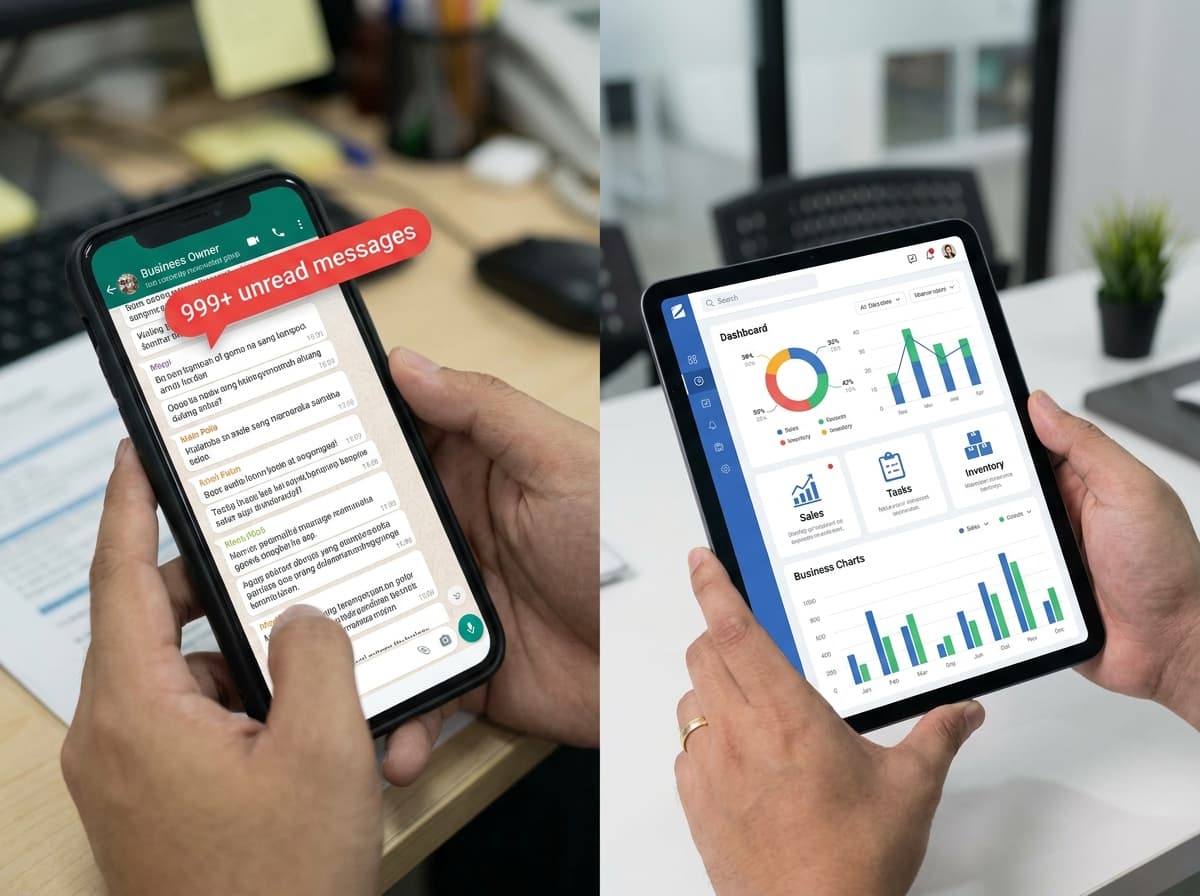
A group chat is not a business system. It is a place where important information goes to get buried under good morning messages.
Across the Philippines, tens of thousands of small and medium businesses are running their operations through WhatsApp, Viber, or Messenger group chats. Orders come in through chat. Delivery assignments happen through voice notes. Inventory is tracked by asking "uy pila pa na stock natin?" in the group.
This works until it does not. And when it fails, it fails in ways that cost real money.
What Actually Goes Wrong With Chat-Based Operations
Orders get lost. When 50 messages come in during a busy day, something gets missed. A customer waits. A complaint follows. A return or refund has to be processed. The team spends an hour trying to figure out what happened.
Accountability disappears. When a task is assigned in a group chat, everyone assumes someone else handled it. There is no system tracking whether it was done or not.
Information is not searchable. You cannot search a WhatsApp chat for "how many orders did we have last Tuesday." The information exists somewhere but it is not usable as business data.
Scaling breaks the system. What works at 20 orders a day collapses at 100. The chat gets overwhelming, the team gets stressed, and errors multiply.
What an Actual Business System Looks Like
The upgrade does not require enterprise software or a large budget. It requires replacing the right parts of the chat-based process with proper tools.
Order management. A simple landing page with an order form, connected to a POS or order tracking system. Orders are automatically recorded, confirmation is sent automatically, and the fulfillment team sees a structured list instead of a chat thread.
Task management. A basic task board where work is assigned, tracked, and marked complete. Not a group chat. Something like Trello or a custom dashboard where it is visible who is responsible for what and whether it is done.
Communication structure. Chat is still useful but for specific purposes: updates, questions, coordination. Not for order-taking, not for inventory tracking, not for assigning work that needs to be completed and confirmed.
Data that you can review. At minimum, a daily summary of orders, revenue, and issues. This can be automated so it arrives without anyone having to compile it.
The Right Pace of Change
Do not overhaul everything at once. Businesses in Cebu, Davao, and Iloilo that tried to replace all of their informal systems in one go usually faced team resistance and abandoned the project.
Replace one process at a time. Start with order management. Get the team comfortable. Then add task tracking. Then reporting. Three months of gradual change produces a stable system. Three weeks of forcing everything produces chaos.
Follow me on Facebook and Instagram for more on building real operational systems for Filipino businesses.
If you want help mapping what your operation actually needs to move off group chats, send me a message.